If you are new to IPTV, the idea can seem complicated at first. You may have heard about IPTV subscriptions, streaming apps, Smart TVs, Firesticks, Android boxes, playlists, and internet requirements.
The good news is that getting started is usually much easier than it sounds.
For viewers searching for IPTV South Africa, IPTV provides an internet-based way to access live television and on-demand entertainment. Instead of relying on traditional satellite infrastructure, IPTV delivers content through your internet connection.
This beginner-friendly guide explains how IPTV works, what you need, how to choose a provider, and how to avoid common problems.
What Is IPTV?
IPTV stands for Internet Protocol Television.
Traditional television typically relies on satellite, terrestrial broadcasting, or cable networks. IPTV uses an internet connection to deliver television content to a compatible device.
In simple terms, your internet connection becomes the delivery method for television programming.
Depending on the service, IPTV can provide access to:
- Live television channels
- Sports
- Movies
- TV series
- News
- Documentaries
- Kids’ entertainment
- Music channels
- International programming
- Video-on-demand content
However, the exact content depends on the provider and its licensing arrangements.
How Does IPTV Work?
The basic process is straightforward.
First, an IPTV provider hosts and delivers television streams through its infrastructure. You then receive access credentials after subscribing.
Next, you install a compatible IPTV player on your chosen device.
Finally, you enter the credentials provided by your IPTV service.
The player connects to the provider’s server and loads the available channels and on-demand content.
IPTVPass, for example, provides username, password, and server URL details for supported setups. Its setup guide uses Xtream Codes API credentials across several compatible applications.
This means you generally do not need complicated technical knowledge to begin.
What Do You Need to Use IPTV?
Before starting, you need a few basic things.
1. A reliable internet connection
IPTV depends on your internet connection. A weak or unstable connection can cause buffering and interruptions.
As a general guide, IPTVPass recommends:
- SD: 5 Mbps
- HD: 10 Mbps
- Full HD: 15–20 Mbps
- 4K: 25 Mbps or more
These figures are recommended per stream. Therefore, households using multiple IPTV devices should allow additional bandwidth.
2. A compatible device
You can watch IPTV on many different devices.
Popular options include:
- Samsung Smart TVs
- LG Smart TVs
- Android TV boxes
- Amazon Fire TV Stick
- Android phones and tablets
- iPhone and iPad
- Apple TV
- Windows computers
- Mac computers
- MAG boxes
- Formuler devices
IPTVPass currently provides setup instructions for several of these platforms.
3. An IPTV player
An IPTV player is the application that connects your device to the IPTV service.
Popular options include IPTV Smarters Pro, Smarters Player Lite, TiviMate, XCIPTV, GSE Smart IPTV, and other compatible players.
The available applications depend on your device.
4. An IPTV subscription
You also need an active subscription from a provider.
The provider should give you the information required to connect your chosen IPTV player.
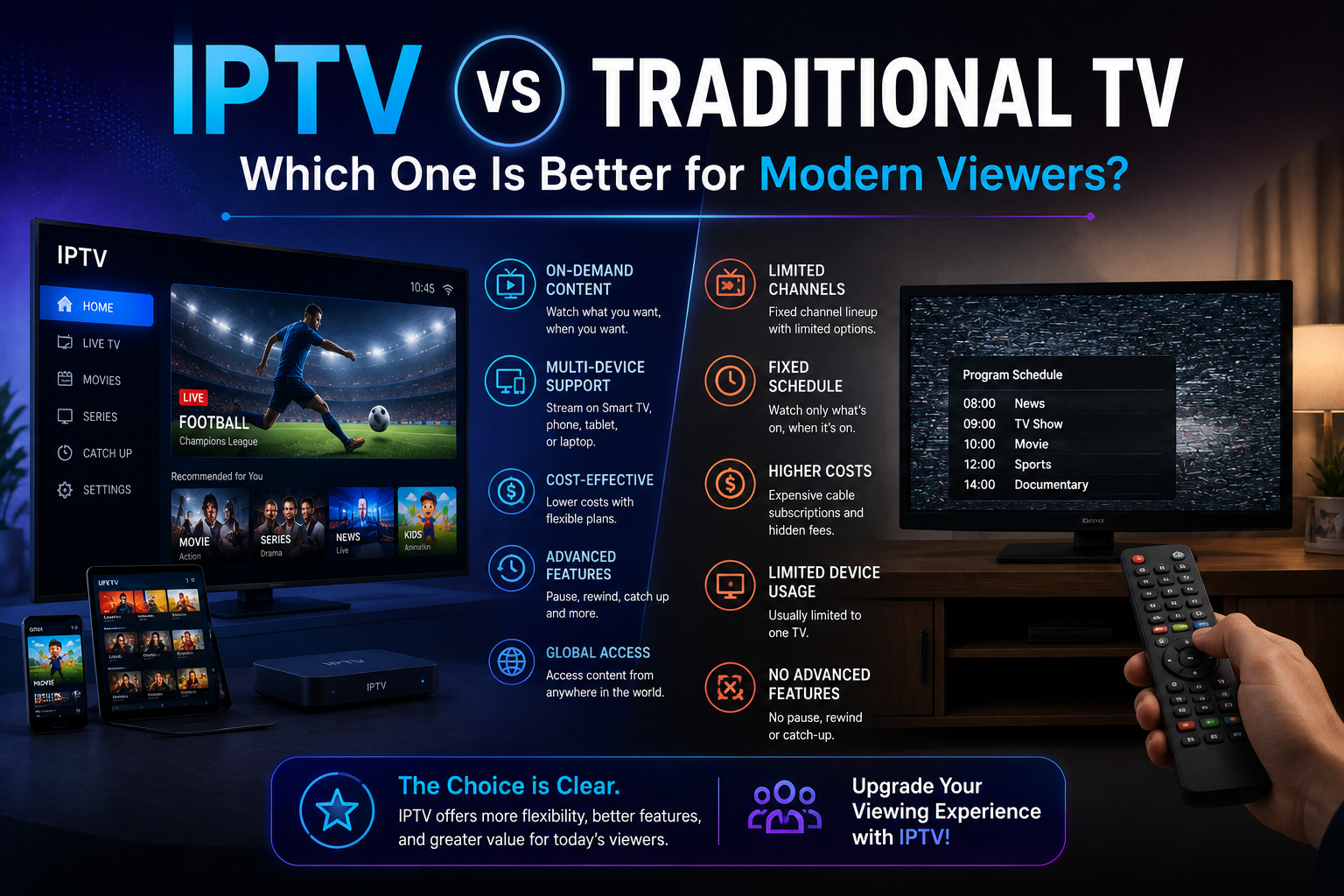
IPTV vs Traditional TV
One of the main differences is how content reaches your television.
Traditional satellite television uses a satellite dish and decoder. IPTV uses your internet connection and a compatible device.
This can make IPTV more flexible.
You can potentially watch your subscription on a television, phone, tablet, or computer. Therefore, IPTV can suit households that want more freedom than a traditional fixed television setup.
However, IPTV depends on internet availability. If your connection goes down, streaming can also stop.
Traditional satellite television has different requirements and limitations.
Neither method is perfect for every household. Your choice depends on your internet connection, equipment, viewing habits, and location.
Which Device Is Best for IPTV?
There is no single best device for everyone.
Smart TV
A modern Smart TV is often the easiest option.
You can install a compatible IPTV player directly on the television. This eliminates the need for an external streaming device.
IPTVPass provides dedicated instructions for Samsung and LG Smart TVs.
Best for: beginners who want a simple setup.
Firestick
The Amazon Fire TV Stick is compact and convenient.
It is particularly useful when your television does not have suitable IPTV applications. You can connect it through HDMI and use it as your streaming platform.
According to IPTVPass’s setup guide, Firestick IPTV installation takes around 15 minutes and involves installing a suitable player through Downloader.
Best for: affordable upgrades and portability.
Android TV Box
An Android TV box offers greater flexibility.
Android devices support a wide selection of IPTV applications. You can also choose different hardware specifications depending on your budget.
Best for: users who want more control and application flexibility.
How to Set Up IPTV
The exact process varies between devices, but the basic steps are similar.
Step 1: Choose your device
Decide whether you want to use a Smart TV, Firestick, Android box, or another compatible device.
Step 2: Connect to the internet
Connect your device to your home Wi-Fi or Ethernet network.
If possible, use Ethernet for a more stable connection.
IPTVPass recommends a LAN connection where available. For Wi-Fi, it recommends using the 5 GHz band when practical.
Step 3: Install an IPTV player
Find a compatible IPTV application for your device.
For example, IPTVPass’s Android TV instructions use IPTV Smarters Pro through the Google Play Store.
Step 4: Enter your subscription details
Your provider should supply the required login information.
Enter your username, password, and server URL carefully.
A single incorrect character can prevent the connection from working.
Step 5: Wait for your content to load
Once authenticated, the application normally loads your live channels, movies, series, and other available content.
You can then browse the categories and begin watching.
How Much Internet Speed Does IPTV Need?
Internet speed is one of the most important factors for IPTV.
A basic HD stream can work with approximately 10 Mbps. Full HD generally benefits from 15–20 Mbps, while 4K requires around 25 Mbps or more per stream.
However, do not focus only on download speed.
Connection stability matters too.
For example, a 50 Mbps connection that frequently drops may perform worse than a stable 20 Mbps connection for HD streaming.
Your household’s other activities also consume bandwidth.
If someone is gaming, downloading large files, or streaming another video at the same time, your IPTV stream has less available bandwidth.
Why Does IPTV Buffer?
Buffering is one of the most common problems beginners encounter.
Several factors can cause it.
Weak Wi-Fi
Your television may be too far from the router.
Walls and other wireless networks can also interfere with the signal.
Slow internet
Your connection may not provide enough bandwidth for the selected resolution.
Network congestion
Internet performance can change during busy periods.
Too many devices
Several devices sharing one connection can reduce available bandwidth.
Poor IPTV application performance
An outdated or unsuitable player may also cause problems.
Provider-side issues
Sometimes the problem is related to the specific stream or provider infrastructure rather than your home network.
How to Improve IPTV Streaming
If your IPTV keeps buffering, try these simple solutions.
Use Ethernet
A wired connection is often the most reliable option.
Use 5 GHz Wi-Fi
If Ethernet is unavailable, connect your device to a 5 GHz network when possible.
Move your router
Place your router somewhere open and relatively central.
Reduce video quality
If 4K playback is unstable, switch to Full HD or HD.
Restart your equipment
Restarting the router and streaming device can resolve temporary problems.
Reduce other network activity
Pause large downloads and unnecessary streaming while watching IPTV.
Test your connection on the IPTV device
Do not rely only on a speed test from your phone. Test the device that is actually experiencing the problem.
What Is an IPTV Playlist?
You may also hear the term IPTV playlist.
A playlist contains information that allows an IPTV player to access available streams.
One common format is an M3U playlist.
Another common method is an Xtream Codes API login, which typically uses a username, password, and server URL.
Different applications support different connection methods.
IPTVPass’s setup guide recommends Xtream Codes API login for several supported players because it provides access to the service’s channel guide and video-on-demand sections.
Your provider should tell you which method to use.
What Is an EPG?
EPG stands for Electronic Programme Guide.
It works similarly to a traditional television programme guide.
Instead of simply displaying channel names, an EPG can show programme information and schedules.
A compatible IPTV player may download this information automatically.
For beginners, enabling automatic EPG updates can make browsing live television much easier.
IPTV for Sports Fans
Live sports are one of the major reasons people explore IPTV.
Depending on the provider and its licensed content, IPTV services can offer access to sports programming alongside regular television.
For South African viewers, local and international sports can be particularly important.
However, sports streaming also demands a stable connection.
A brief interruption can be frustrating during a live match. Therefore, Ethernet or strong 5 GHz Wi-Fi can be especially useful for sports viewing.
Can You Watch IPTV on Multiple Devices?
Many IPTV services support several types of devices.
However, this does not automatically mean that one subscription can stream simultaneously on unlimited devices.
The number of simultaneous connections depends on your subscription plan.
IPTVPass explains that one subscription streams to one device at a time unless a multi-device plan has been purchased.
Therefore, check the provider’s connection policy before sharing an account across multiple televisions.
Is IPTV Legal?
This is an important question for every beginner.
IPTV technology itself is legal.
The important issue is the content being distributed.
A legitimate IPTV service should have the necessary rights or licences to distribute the channels and content it offers.
Therefore, do not judge an IPTV service only by its channel count or low price.
Before subscribing, consider:
- Whether the provider has appropriate content rights
- Whether the service clearly explains its terms
- Whether pricing is transparent
- Whether customer support is available
- Whether the provider identifies the services it offers clearly
You should also make sure your use complies with the laws and licensing requirements that apply in your country.
How to Choose an IPTV Provider
There are many IPTV services available online.
Unfortunately, quality can vary considerably.
A reliable provider should offer more than a large channel list.
Look for clear pricing
Avoid providers that hide important costs until checkout.
Check device compatibility
Make sure your preferred Smart TV, Firestick, or Android box is supported.
Look for setup instructions
A good provider should explain how to connect your device.
Check customer support
Support is particularly valuable when you are new to IPTV.
Consider streaming quality
Look for suitable HD and 4K options if those resolutions matter to you.
Review the legal position
Make sure the content you intend to watch is appropriately licensed.
IPTV South Africa: What Beginners Should Consider
South African viewers have some specific factors to consider.
Internet infrastructure varies between households. Some users rely on fibre, while others use LTE, 5G, or other connections.
Load shedding can also affect home networking equipment.
If you want to continue streaming during a power interruption, your router, fibre ONT, television, and streaming device all need appropriate backup power.
Your internet package also matters.
For regular HD IPTV, 10 Mbps per stream is a useful starting point. For 4K, 25 Mbps or more per stream is recommended by IPTVPass.
Therefore, choose your internet package according to the number of people and devices using your connection.
Common IPTV Beginner Mistakes
New users often make a few simple mistakes.
Entering login details incorrectly
Usernames and passwords can be case-sensitive.
Always copy the information carefully.
Choosing the wrong login method
If your provider gives you Xtream Codes credentials, select the appropriate Xtream login option instead of randomly choosing another method.
Using weak Wi-Fi
Your IPTV device may work better when placed closer to the router.
Expecting 4K on any connection
4K requires significantly more bandwidth.
Buying an unnecessarily complicated device
Beginners often assume they need expensive hardware.
In reality, a compatible Smart TV or affordable streaming device may be enough.
Ignoring the provider’s instructions
Every service can have different setup requirements.
Following the provider’s official instructions can save considerable time.
A Simple IPTV Setup for Beginners
If you want to keep things straightforward, use this basic approach:
1. Choose a compatible device.
A modern Smart TV, Firestick, or Android TV box is a good starting point.
2. Make sure your internet is stable.
Aim for at least 10 Mbps for HD and 25 Mbps or more for 4K.
3. Choose a reputable provider.
Check device compatibility, support, pricing, and content licensing.
4. Install a suitable IPTV player.
Use an application compatible with your device.
5. Add your subscription details.
Enter the credentials supplied by your provider.
6. Test several channels.
Try different categories and resolutions.
7. Improve your network if necessary.
Use Ethernet or stronger Wi-Fi if you experience buffering.
This simple process is enough for most beginners.
Get Started With IPTV South Africa
If you are looking for an IPTV service designed for South African viewers, you can explore the available options at IPTVPass.co.za.
IPTVPass currently advertises more than 22,000 live channels and 90,000 movies and series, with HD, Full HD, and 4K streaming options.
Its setup guide also provides detailed instructions for supported devices, including Smart TVs, Android TV boxes, Firesticks, Apple devices, computers, MAG boxes, Formuler devices, and Roku.
Before subscribing, always confirm that the content you want to access is properly licensed and that your intended use complies with applicable laws.
Final Thoughts
Getting started with IPTV does not have to be complicated.
You mainly need a reliable internet connection, a compatible device, a suitable IPTV player, and a legitimate service.
For beginners, a Smart TV can provide the simplest setup. A Firestick offers convenience and portability, while an Android TV box provides greater flexibility.
Your internet connection is equally important. Aim for around 10 Mbps for HD, 15–20 Mbps for Full HD, and at least 25 Mbps for 4K per stream.
Most importantly, take your time when choosing a provider. Look beyond channel numbers and consider reliability, device support, customer service, pricing, and content licensing.
With the right setup, IPTV South Africa can provide a flexible way to enjoy live television and on-demand entertainment across compatible devices.